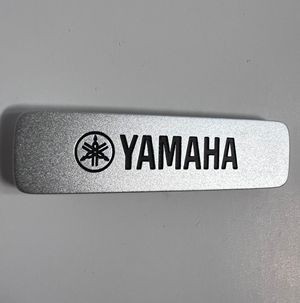
What are electroformed nickel labels?
Run your finger over the raised logo on a nice refrigerator or perfume bottle. That badge is almost certainly electroformed nickel. It looks like a solid cast piece, bright and sharp-edged, but it's actually a sticker. Thin enough to wrap around a curved panel, hard enough to last as long as the product.
These labels, sometimes called nickel transfer labels or 3D metal logos, are made by electroforming. Nickel is electrically deposited onto a precision mold, rather than stamped or etched out of a sheet of metal. The result is a logo as thin as 0.04–0.15 mm, with sharp raised 3D detail and a high-bond 3M adhesive on the back.
Brands pick them for the same reason they'd pick a solid metal badge: the premium look, at a fraction of the tooling cost and weight.
Why brands choose nickel labels over other options
Real metal, not printed. The logo is actual nickel with a PVD chrome or gold finish. It doesn't look like a sticker.
They bend. A 0.05 mm label conforms to cylinders, rounded corners, and contoured panels that rigid plates can't follow.
They last. PVD-coated nickel resists abrasion, sweat, UV, steam, and cleaning chemicals. Finish stays consistent for years.
Peel-and-stick. No screws, brackets, or assembly. Production-line workers just position and press.
If the logo is going to be touched in the showroom, nickel beats printed, domed, or plastic badges on perceived quality every time.
How electroforming works
Electroforming builds metal onto a mold, atom by atom. Here's how it goes:
Your vector logo is turned into a precision conductive mold.
The mold goes into a nickel plating bath where electric current deposits nickel onto the raised areas.
The nickel logo grows to the exact thickness you want - usually 0.05–0.10 mm for most products.
A PVD coating adds the finish color: chrome, gold, rose gold, or black, in mirror or brushed texture.
A clear seal coat goes on top, then 3M adhesive on the back.
Labels come on a transfer carrier (sheet or roll), ready to peel and stick.
The mold is what gives electroforming its sharp detail. Even small fonts and fine lines come out crisp, because the feature size is controlled by the phototool, not by a stamping die.
Where you'll see them
Nickel labels show up anywhere a brand wants the logo to feel expensive:
Home appliances - cookers, fridges, kettles, coffee machines, range hoods
Consumer electronics - earbuds, speakers, chargers, smart-home devices
Perfume and cosmetics - bottle caps, compacts, lipstick tubes, gift boxes
Automotive - interior trim, exterior emblems, audio systems
Furniture and fitness - signature marks on wood, leather, gym consoles
If you've ever looked at a product and thought "that logo looks expensive," it was probably electroformed nickel.
What finishes are available?
Chrome (silver) - the classic, bright mirror finish
Gold - warm mirror gold, used heavily in cosmetics and premium appliances
Rose gold - popular for beauty and 3C products
Black / gunmetal - used on high-end audio, automotive, and consumer tech
All finishes are PVD-coated and sealed, so they resist tarnish, abrasion, and cleaning chemicals. You can also choose between mirror and brushed textures.
How much do they cost?
Pricing depends on size, finish, quantity, and whether there's a mold fee for the first order. As a rough guide, a 20–30 mm logo in a standard chrome finish usually lands somewhere between a few cents and a dollar each, depending on volume. Unit price drops fast as quantity goes up.
The only one-time cost is the mold. Once it's made, reorders have no tooling charge.
How to get started
Thinking about nickel labels for a product? Send us your logo and a photo of the surface it's going on. We'll tell you if it's a good fit, suggest a thickness and finish, and quote tooling and unit pricing. Want to see the finish in person? We can send a sample set.
What are electroformed nickel labels?
Run your finger over the raised logo on a nice refrigerator or perfume bottle. That badge is almost certainly electroformed nickel. It looks like a solid cast piece, bright and sharp-edged, but it's actually a sticker. Thin enough to wrap around a curved panel, hard enough to last as long as the product.
These labels, sometimes called nickel transfer labels or 3D metal logos, are made by electroforming. Nickel is electrically deposited onto a precision mold, rather than stamped or etched out of a sheet of metal. The result is a logo as thin as 0.04–0.15 mm, with sharp raised 3D detail and a high-bond 3M adhesive on the back.
Brands pick them for the same reason they'd pick a solid metal badge: the premium look, at a fraction of the tooling cost and weight.
Why brands choose nickel labels over other options
Real metal, not printed. The logo is actual nickel with a PVD chrome or gold finish. It doesn't look like a sticker.
They bend. A 0.05 mm label conforms to cylinders, rounded corners, and contoured panels that rigid plates can't follow.
They last. PVD-coated nickel resists abrasion, sweat, UV, steam, and cleaning chemicals. Finish stays consistent for years.
Peel-and-stick. No screws, brackets, or assembly. Production-line workers just position and press.
If the logo is going to be touched in the showroom, nickel beats printed, domed, or plastic badges on perceived quality every time.
How electroforming works
Electroforming builds metal onto a mold, atom by atom. Here's how it goes:
Your vector logo is turned into a precision conductive mold.
The mold goes into a nickel plating bath where electric current deposits nickel onto the raised areas.
The nickel logo grows to the exact thickness you want - usually 0.05–0.10 mm for most products.
A PVD coating adds the finish color: chrome, gold, rose gold, or black, in mirror or brushed texture.
A clear seal coat goes on top, then 3M adhesive on the back.
Labels come on a transfer carrier (sheet or roll), ready to peel and stick.
The mold is what gives electroforming its sharp detail. Even small fonts and fine lines come out crisp, because the feature size is controlled by the phototool, not by a stamping die.
Where you'll see them
Nickel labels show up anywhere a brand wants the logo to feel expensive:
Home appliances - cookers, fridges, kettles, coffee machines, range hoods
Consumer electronics - earbuds, speakers, chargers, smart-home devices
Perfume and cosmetics - bottle caps, compacts, lipstick tubes, gift boxes
Automotive - interior trim, exterior emblems, audio systems
Furniture and fitness - signature marks on wood, leather, gym consoles
If you've ever looked at a product and thought "that logo looks expensive," it was probably electroformed nickel.
What finishes are available?
Chrome (silver) - the classic, bright mirror finish
Gold - warm mirror gold, used heavily in cosmetics and premium appliances
Rose gold - popular for beauty and 3C products
Black / gunmetal - used on high-end audio, automotive, and consumer tech
All finishes are PVD-coated and sealed, so they resist tarnish, abrasion, and cleaning chemicals. You can also choose between mirror and brushed textures.
How much do they cost?
Pricing depends on size, finish, quantity, and whether there's a mold fee for the first order. As a rough guide, a 20–30 mm logo in a standard chrome finish usually lands somewhere between a few cents and a dollar each, depending on volume. Unit price drops fast as quantity goes up.
The only one-time cost is the mold. Once it's made, reorders have no tooling charge.
How to get started
Thinking about nickel labels for a product? Send us your logo and a photo of the surface it's going on. We'll tell you if it's a good fit, suggest a thickness and finish, and quote tooling and unit pricing. Want to see the finish in person? We can send a sample set.